
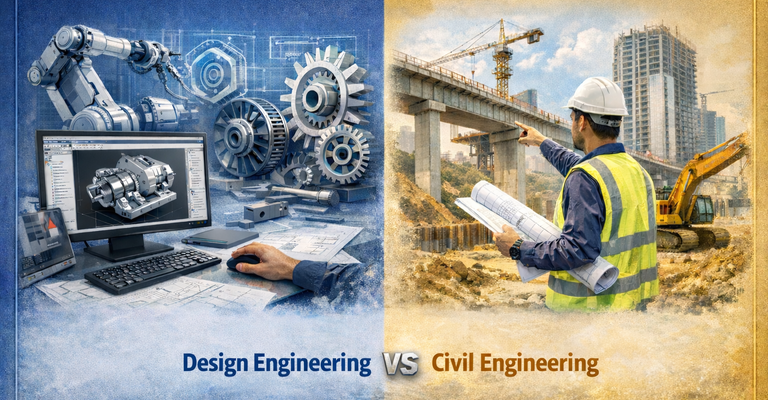
The term civil engineering in the construction and infrastructure sphere is used interchangeably with site design engineering. Although they are very close together, they are not similar fields. Civil engineering is a broad professional discipline, whereas site design engineering is a sub-discipline of civil engineering.
In this article, the fundamental distinctions between site design engineering and civil engineering are highlighted with respect to their functions, duties, and their roles in enabling the successful completion of a project.
Site Design Engineering Vs Civil Engineering
Major Civil Engineering Disciplines
Civil engineering can be subdivided into a range of specialised disciplines that discuss various issues in the built environment and natural environment:
- Structural engineering: Design and analysis include buildings, bridges, towers, and load-bearing structures.
- Geotechnical engineering: Foundations, earth-retaining systems, and soil investigation.
- Civil/chemical engineering: Environmental, waste management, water treatment, air pollution control, and sustainability.
- Transportation engineering: Roads, highways, rails, air transport, and traffic modalities.
- Water resources engineering: A dam, drainage, flood management, and water supply.
- Construction engineering: Planning, logistics, contracts, and execution strategies
- Municipal or urban engineering: Engineering Municipal utility, street, civicwork.
What Is Site Design Engineering?
Construction site engineering (also known as site design engineering) is much more execution-oriented. It concerns the application of the approved designs on the ground, so that construction works are carried out in accordance with drawings, specifications, schedules,, and quality standards.
The site design engineer spends the majority of the time at the site and is the technical mediator between the design groups and the construction team.
Key Responsibilities of Site Design Engineers
- Understanding construction drawings and technical specifications.
- Doing site visits and quality control.
- Coordination of the contractors, subcontractors, and suppliers.
- Planning schedules and work plans for the site.
- Supervision of surveys and layout before execution.
- Ensuring that safety measures are in place on site.
To achieve efficient, precise design and practical performance, Valdez Engineering could be a good choice as a partner, as its civil engineering services offer expertise in strategic project design and precise construction.
Project Development vs. Project Execution
The difference that can be of utmost importance is the timing and the contribution of each role to a project.
Civil engineers are highly technical and focus on feasibility analysis and detailed design. They have specialised software, make complicated calculations, and prepare drawings of construction works that serve as a guide throughout the construction.
On the contrary, site design engineers check the accuracy of what is constructed on-site to the same extent as those designs. They translate drawings into field implementation, schedule activities at the sites, and document the conditions of the vocational levels as they come along.
Documentation and Coordination.
It is the process of organizing and documenting information.
Civil engineers normally deal with client coordination and, at a high level, with documentation such as design reports, approvals, and compliance records. During the design process, they provide association with architects, consultants, and regulatory agencies.
Site design engineers are involved in the day-to-day documentation at the site, which includes:
- RFIs (requirements in the form of requests)
- Shop drawings
- Submittals
- Daily progress reports
They also coordinate directly with contractors and subcontractors, monitoring performance and ensuring quality standards are met consistently.
Safety and Regulatory Compliance
Safety is a collective responsibility that is addressed in different ways.
Civil engineers determine safety standards, specifications, and compliance structures, such that the project is in line with the legal, environmental, and sustainability standards.
The site design engineers are called upon to install and enforce such safety standards on the construction site. They also give instant technical advice, sort out on-site problems, and ensure that work practices are carried out as required during work.
During the design and planning processes, civil engineers are very significant in terms of budgeting, estimating costs, and allocating resources. They ensure that materials and equipment are in line with project requirements and schedules.
Why Choosing the Right Civil Engineering Partner Matters
In the projects where there is a need to integrate the strategic design knowledge and practical implementation knowledge, the experience of the civil engineering firm will make a noticeable difference. When planning accuracy, regulations, and coordination of construction come together under a single roof, they are done by professional civil engineers.
Such companies as Valdez Engineering are the exception here. Their civil engineering service is based on providing well-coordinated designs that can be easily implemented in the actual construction of the project, so that projects are not required to go through the length and breadth to complete the construction.
Final Thoughts
Although the disciplines of civil and site design engineering are quite comparable, they play different (yet complementary) roles. The site design engineers implement the vision created by the civil engineers in the project in terms of the exact work on-site by utilizing their design and their own compliance regulations.
Awareness of this divergence will assist project owners in forming the appropriate team of expertise, so that their projects are not only developed well but also delivered safely and efficiently.