
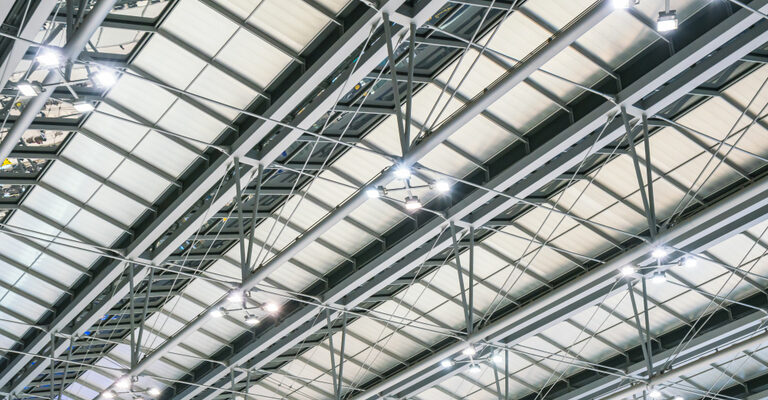
Cold-formed steel (CFS) is a highly-strength and thin steel material that is manipulated at room temperature to take the form of studs, tracks, channels, angles, and custom profiles. Since it is cold-rolled (as opposed to hot-rolled sections), CFS is cut into accurate dimensions, smooth finishes, and maximum strength-to-weight ratios, making it a favorite material in light structures like wall frames, roof trusses, floor joists, facades and assemblies.
Why CFS Works So Well for Light Structures
1) Light weight- high strength
CFS also offers high stiffness as well as strength at a fraction of the weight of conventional hot-rolled sections or timber. The lightness of members also implies that it is easy to handle, gives the foundation a smaller size, and the construction can be completed more quickly, particularly in multi-storey light-gauge constructions or on roof extensions where the weight is significant.
2) Linear accuracy and straightness
Members of factories are formed straight, true and pre-punched to services. This accuracy makes it easier to align, install drywall and interfaces to the facade, reduces rework and eliminates site time.
3) Versatile design options
A wide profile and thickness catalogue gives the engineer control of capacity, span and deflection. Webs can have custom lips, ribs and embossments applied to add stiffness or enhance the performance of screws without adding material.
4) Speed and constructability
The CFS frames are perfectly designed to be used in panelization and modular building. Cassettes of walls and the floors may be assembled in advance, off-site–
and then craned to the job, including sheathing, insulation, and MEP penetrations–and then craned to the job to be speedily closed in.
5) Sustainability and longevity.
Zinc finishes prevent corrosion of steel; when well-detailed and maintained, CFS frames are long-lived. Steel is also extremely recyclable, and the light mass of CFS structures also aids in the reduction of the embodied carbon compared to heavier systems with the same functionality.
Key Engineering Considerations
Section behavior
Since CFS members are thin-walled, they are vulnerable to local, distortional and global buckling. The current design procedures take these effects into explicit consideration, and commonly, the effective-width concepts or direct strength methods are used to incorporate the post-buckling capability. Ways of improving stability include stiffening lips and intermediate web stiffeners.
Connections
They use screws, bolts, rivets, and welds, but the most popular ones are self-drilling screws that are used in light framing. Shear, bearing, pull-out and pull-over capacities and sheet tearing are considered by engineers. Patterns of screws and distances between the edges are quite important to the performance and speed on-site of repetitive members.
Fire, acoustics and thermal performance.
CFS frames are easily combined with gypsum boards and mineral wool, as well as cavity insulations, to achieve fire ratings and sound transmission objectives. Continuous insulation and thermal breaks assist in restricting thermal bridging by means of metal studs and enhancing envelope performance, whether in a hot or cold climate.
Corrosion protection
Depending on exposure, galvanized finishes (e.g. Z180, Z275 and more) are chosen. In case of high humidity or coastal surroundings, engineers can request heavier finishes, more paint applications or stainless fasteners. Details such as not letting water traps form or sealing cut edges are good detailing, which increases service life.
Codes and design standards
Design is generally carried out to meet a set of standards (e.g. AISI S100 in the United States of America or Eurocode 3 Part 1-3 in Europe) with load combinations related to the local building code. These standards dictate member abilities, supporting needs, interconnection design and serviceability boundaries.
Standard Uses of Light Structures.
- Walls: Residential, healthcare, hospitality and commercial residential load and non-load bearing stud walls.
- Floors and roofs: Joists, rafters and trusses which are long-distance with less depth.
- Façades and rain screens: Framing, Secondary support frame, cladding, and curtain wall cladding, curved or tailor-made geometry.
- Modular and volumetric units: Prefabricated pods and room modules to provide quality delivery at a fast rate and consistency.
- Retrofits and additions on the roof: Lightweight framing has the least effect on the structures and foundations.
Cold-formed steel: Is it the Right Choice?
Use CFS when the construction must be fast, clean, and the quality is predictable – particularly where multiple storeys and light framing are required, facades, tenant improvements, schools, clinics, hotels, and modular construction. In the case that your project is characterized by strict tolerance needs, as well as the lack of crane capacity or a fast schedule, CFS tends to offer the most optimal combination of performance, cost, and speed.